
Guide
Types of Roof Shingles
Nearly every shingle sold in America is asphalt, and the choice within asphalt comes down to three grades. The other materials are a much smaller market that costs two to five times as much and lasts two to five times as long.
Asphalt shingles come in three grades: 3-tab (flat, single layer, 15 to 20 years), architectural or dimensional (laminated, two or more layers, 25 to 30 years), and luxury or designer (heavier laminates imitating slate or shake, 30 to 50 years). Beyond asphalt the options are wood shake, natural slate, clay or concrete tile, metal and composite. Architectural asphalt is the default on most American homes because it is the cheapest option that performs well.
The three grades of asphalt shingle
All three are the same idea: a fibreglass mat, saturated in asphalt, surfaced with ceramic granules that take the UV damage. What separates them is how many layers are laminated together, which drives weight, wind resistance and life.
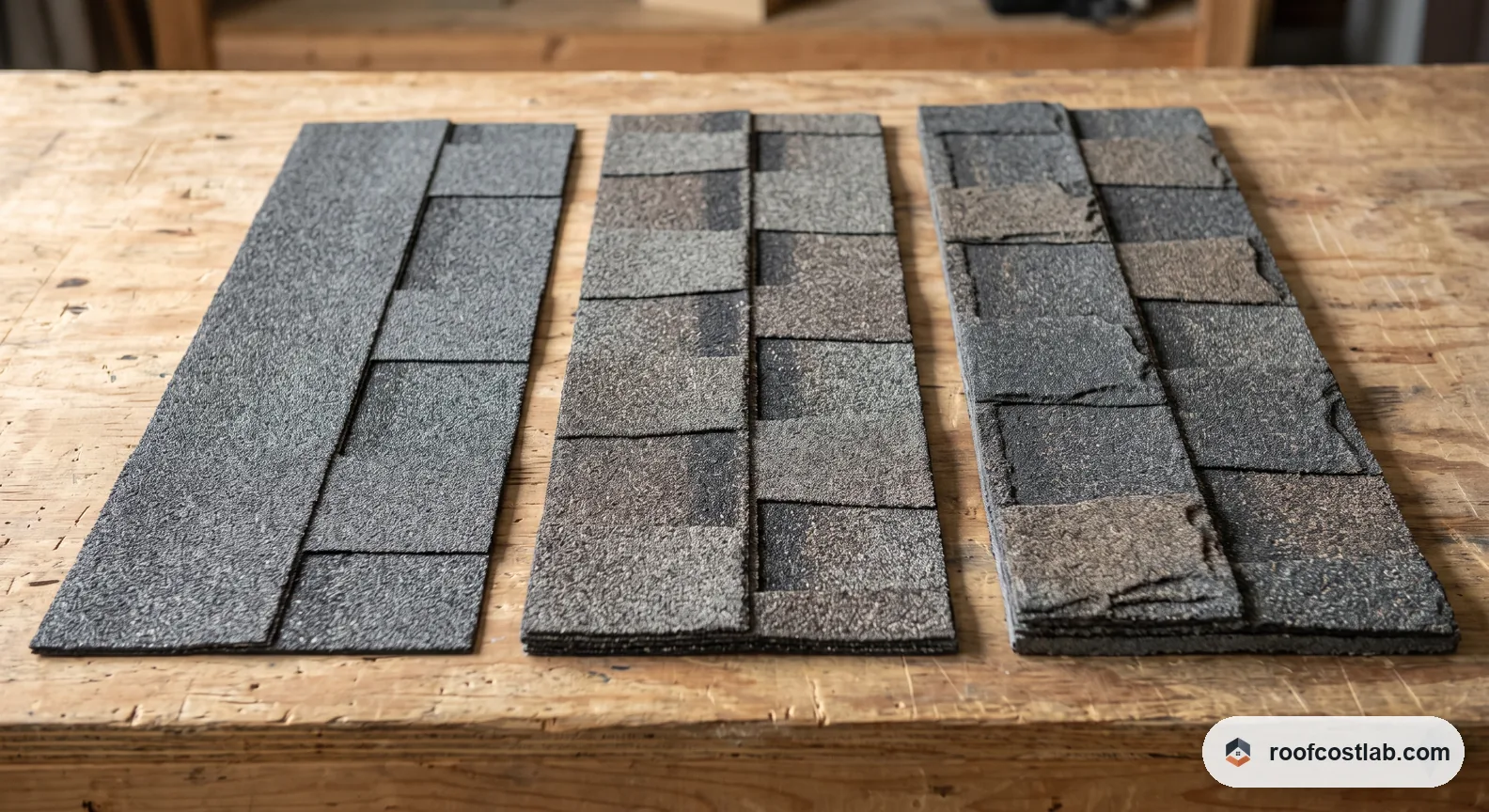
- 3-tab shingles
- A single flat layer, cut into three tabs per strip so the finished roof reads as uniform rectangles. The cheapest asphalt shingle and the lightest, at roughly 200 to 240 lb per square. Wind ratings are typically 60 to 70 mph. Still specified for rentals, sheds and budget replacements, but largely displaced on owner-occupied homes.
- Architectural (dimensional or laminated) shingles
- Two or more layers bonded together, cut irregularly so the roof gets depth and shadow. Around 240 to 340 lb per square, wind ratings commonly 110 to 130 mph. This is the default choice on most American homes and the grade our shingle calculator assumes unless you tell it otherwise.
- Luxury (designer or premium) shingles
- Heavier laminates, often three layers, shaped and coloured to imitate natural slate or cedar shake at a fraction of the weight. 400 lb per square and up. They buy the look of slate without the structural work slate demands, at roughly double the cost of architectural.
- Impact-resistant shingles
- Not a fourth grade but a rating that can apply to any of them, from Class 1 to Class 4 under UL 2218. Class 4 survives a two-inch steel ball dropped twice on the same spot, and many insurers discount premiums for it in hail states. Worth pricing where hail is a regular event.
Architectural versus 3-tab, which is the real question
For most homeowners the decision is not among all shingle types. It is between these two, and the gap has narrowed to the point where 3-tab rarely wins.
Architectural costs roughly $1 to $1.50 more per square foot installed. Over a 1,700 sq ft roof that is somewhere around $1,700 to $2,500. In exchange you get ten to fifteen more years of service life, close to double the wind rating, and a warranty that is usually longer. On cost per year of service, architectural is cheaper.
The cases where 3-tab still makes sense are narrow and real: a rental or a flip where the holding period is short, a detached garage or shed, matching an existing 3-tab roof on a partial replacement, or an HOA that specifies it. Outside those, the cheaper shingle is the more expensive decision.
| 3-tab | Architectural | Luxury | |
|---|---|---|---|
| Layers | One | Two or more | Three or more |
| Life | 15 to 20 yr | 25 to 30 yr | 30 to 50 yr |
| Weight per square | 200 to 240 lb | 240 to 340 lb | 400 lb and up |
| Wind rating | 60 to 70 mph | 110 to 130 mph | 110 to 130 mph |
| Installed / sq ft | $4.50 to $6.50 | $5.50 to $8.00 | $10.00 to $16.00 |
| Looks like | Flat, uniform rows | Depth and shadow | Slate or shake |
Installed figures are computed from our own material and labor dataset, not copied from a cost guide. Price a specific roof with the roof replacement calculator.
The materials that are not asphalt
Together these are a small share of the American market, and every one of them is a longer commitment than asphalt. Two things decide whether they are even available to you: what the roof structure can carry, and what the slope allows.
Weight is the hard limit. Slate and clay tile weigh three to ten times what asphalt does, so putting either on a house framed for shingles means structural reinforcement, and that engineering assessment has to happen before you commit to the material rather than after.
- Wood shake and shingle
- Cedar, sawn or split. Weathers to grey, lasts 25 to 40 years in a dry climate and much less in a damp one, and is restricted or banned outright in many wildfire zones. Costs sit at cedar shake installation.
- Natural slate
- Quarried stone, 75 to 150 years, and the only common roof likely to outlast the building. Very heavy and expensive to repair because matching stone is hard to source. See slate roof cost.
- Clay and concrete tile
- Standard in hot dry climates and on Spanish and Mediterranean styles. 50 to 100 years, heavy, and individually fragile underfoot, which makes any later roof work more expensive. See tile replacement cost.
- Metal
- Standing seam or exposed fastener, 25 to 70 years depending on which. Light enough to go over an existing roof in many cases, and the usual choice for wildfire zones and long-term ownership. Price it at the metal roof calculator.
- Composite and synthetic
- Moulded polymer imitating slate or shake, at a fraction of the weight and without the fire risk of wood. Lifespans are manufacturer claims rather than a century of field evidence, which is the honest caveat on the category.
- Solar shingles
- Photovoltaic units that replace rather than sit on the covering. Far more expensive per square foot than a conventional roof plus panels, and the economics only work where roof replacement and solar were both due anyway.
What to read on the spec sheet
Shingles are sold on brand and colour, and neither tells you much. Four numbers do.
Wind rating is an ASTM D7158 or D3161 class, and it only holds if the shingle was nailed as specified. Most wind failures are nailing failures, not product failures. Impact class is UL 2218 Class 1 to 4, and Class 4 is what earns an insurance discount. Weight per square is the most honest proxy for quality within a grade, because laminate layers are what you are paying for. Warranty length is the least useful of the four: most are prorated after the first decade and nearly all are void if the roof was installed outside the manufacturer instructions or ventilated inadequately, which makes roof ventilation a warranty issue as much as a comfort one.
How many shingles a roof needs
Shingles are sold by the bundle and specified by the square, which is 100 sq ft of finished roof. Three bundles cover a square for most architectural products, four for some heavy laminates.
The figure that catches people out is that roof area is not house area. A 1,700 sq ft footprint at a 6/12 pitch is about 1,900 sq ft of roof surface before waste, because the slope adds length the floor plan does not show. Add 10% waste on a simple gable, 15% on a hip, and up to 20% on a cut-up roof with dormers and valleys. The shingle calculator does all of that, including starter strip, ridge cap and underlayment.