
Guide
Roof Flashing Types
Most roof leaks are not failures of the roof covering. They happen where the covering stops: at a wall, a chimney, a pipe or a valley. Flashing is what closes those joints, and knowing the names makes a roofing estimate readable.
Roof flashing is thin sheet metal installed wherever the roof surface meets something else, to carry water back onto the shingles instead of into the joint. The main types are step flashing at a sloping wall, apron or headwall flashing at a horizontal wall, counter flashing over the top of it, valley flashing where two slopes meet, drip edge at the eaves and rakes, kick-out flashing where a roof edge meets a wall, and pipe boots around vent pipes.
What flashing does, and why leaks start here
A shingle roof is not waterproof in the way a bathtub is. It is a set of overlapping layers that work because water runs down them fast enough never to get underneath. That logic holds across an open field of shingles and breaks the moment something interrupts it: a chimney, a wall, a skylight, a plumbing vent, or the line where two slopes meet.
Flashing restores the overlap at those interruptions. Done properly it is woven into the shingle courses so every piece laps the one below, and water crossing it is handed back onto the surface. Done as a bead of sealant across a joint, it works for two or three years and then does not, because sealant moves and metal does not.
This is why the details around the covering matter out of proportion to their cost. Flashing is a small fraction of a roofing bill and the origin of the large majority of leaks.
The types, and where each one goes
Flashing is named for its position, not its shape, which is why the list looks longer than it is. Learn the location and the name follows.
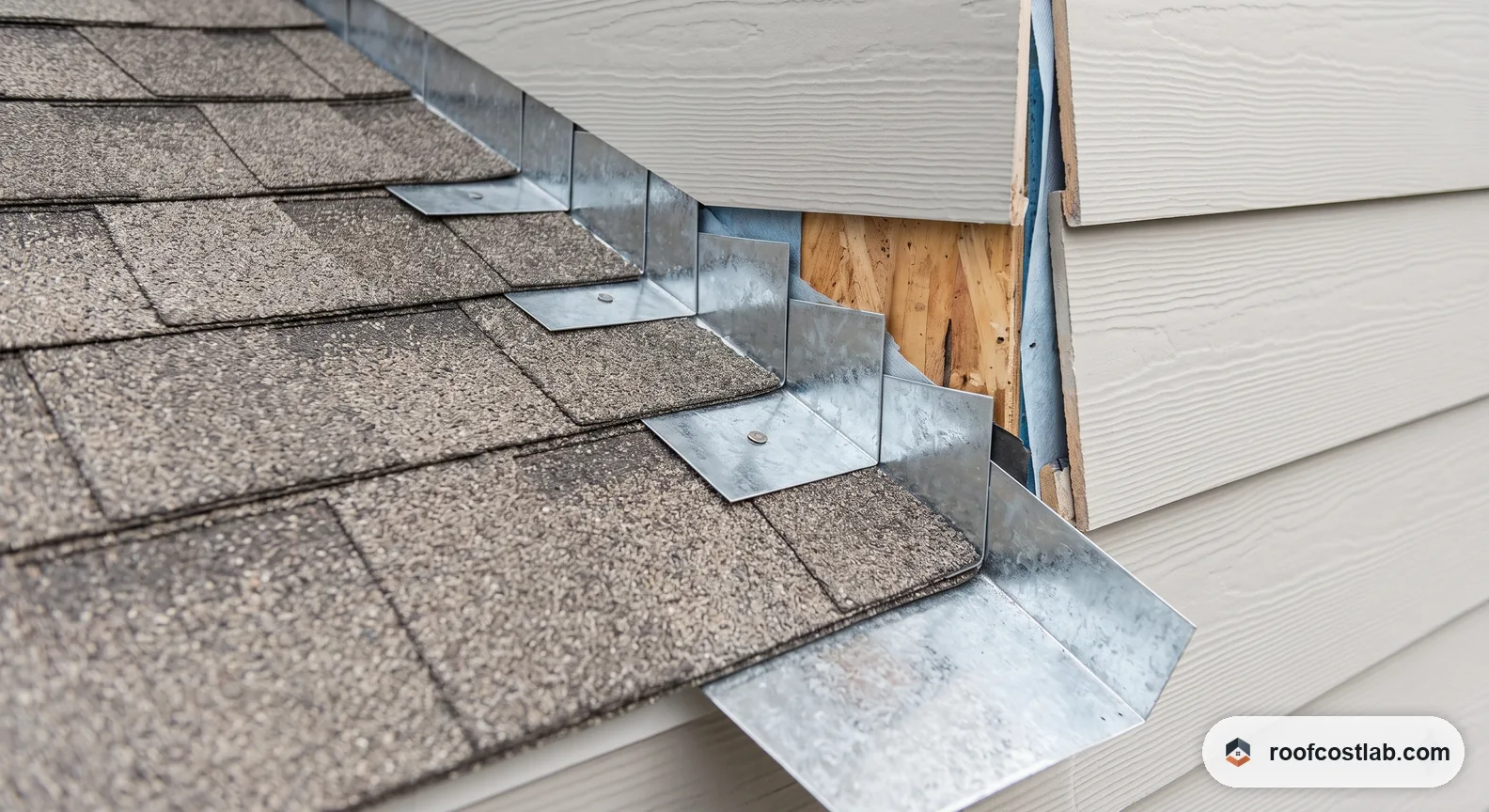
- Step flashing
- Individual L-shaped pieces, one per shingle course, woven up a wall that runs with the slope. Each piece laps the one below like a staircase. The single most common serious error in roofing is replacing this with one long strip of metal, which has no lap and leaks the first time water runs sideways. Priced at roof flashing installation.
- Apron or base flashing
- A single continuous L-shaped piece where the roof meets a horizontal wall or the front of a chimney. Because the joint is horizontal, one piece is correct here, unlike a sloping wall.
- Headwall flashing
- Apron flashing at the top of a roof slope where it dies into a wall, so water arriving from above is turned out onto the shingles rather than running behind the siding.
- Counter flashing
- A second layer set into a groove cut in the masonry, lapping over the top of the base or step flashing so water cannot enter the joint from above. Chimneys need both layers. One alone is not a chimney flashing. Failure here means chimney flashing repair.
- Valley flashing
- Metal running the length of an internal angle where two slopes meet. Valleys carry more water than any other part of the roof, which is why they are a frequent leak site and why valley repair is a common job. Open valleys leave the metal visible; closed valleys run shingles across it.
- Kick-out flashing
- A small angled piece at the very bottom of a step flashing run, where the roof edge meets a wall, that kicks water clear of the siding and into the gutter. Frequently omitted. Where it is missing, water runs down inside the wall and the damage shows up as rot far below the roof.
- Drip edge
- Metal along the eaves and rakes that directs water into the gutter and away from the fascia. Code-required, inexpensive, and often the only flashing a simple roof has.
- Pipe boot (vent pipe flashing)
- A metal flange with a rubber collar that seals around a plumbing vent stack. The rubber perishes in 10 to 15 years while the roof around it is still sound, making this one of the most common and cheapest causes of a leak. Covered under flashing repair.
- Skylight flashing
- A kit specific to the unit, usually a combination of apron, step and head pieces plus a counter piece that clips over them. Skylight curbs leak more often than skylights do, and the flashing is why. Costs sit with skylight installation.
- Drip edge vent
- Drip edge manufactured with a perforated section so it doubles as attic intake. Useful where a roof has no soffit to vent through. See roof vent types.
Flashing materials compared
Material matters more than most homeowners expect, because flashing outlives shingles when it is chosen well and fails early when it is not. Two rules cover most of it: do not put aluminium in direct contact with masonry or treated lumber, and do not mix metals on a metal roof.
That second rule is galvanic corrosion. Aluminium flashing against a steel panel, or a copper gutter under a galvanised roof, sets up a small electrical cell that eats the less noble metal. Match the flashing to the roofing metal or use a compatible barrier.
| Material | Life | Relative cost | Where it belongs |
|---|---|---|---|
| Aluminium | 20 to 35 yr | Low | Most asphalt roofs. Not against masonry or treated wood. |
| Galvanised steel | 20 to 30 yr | Low | The common default. Rusts at cut edges once the coating is breached. |
| Copper | 70 to 100 yr | High | Chimneys, valleys, historic work. Stains adjacent stone green. |
| Lead | 100+ yr | High | Complex masonry shapes. Restricted in some jurisdictions. |
| Stainless steel | 50+ yr | High | Coastal and marine exposure where everything else corrodes. |
| Lead-coated copper | 70 to 100 yr | Highest | Copper durability without the green staining. |
Lifespans assume correct installation and no galvanic pairing. A well-chosen flashing normally outlasts the shingles over it, which is why flashing is often reused on a re-roof and why that decision deserves scrutiny.
How flashing actually fails
Four failure modes cover most of it, and only one is about the metal wearing out.
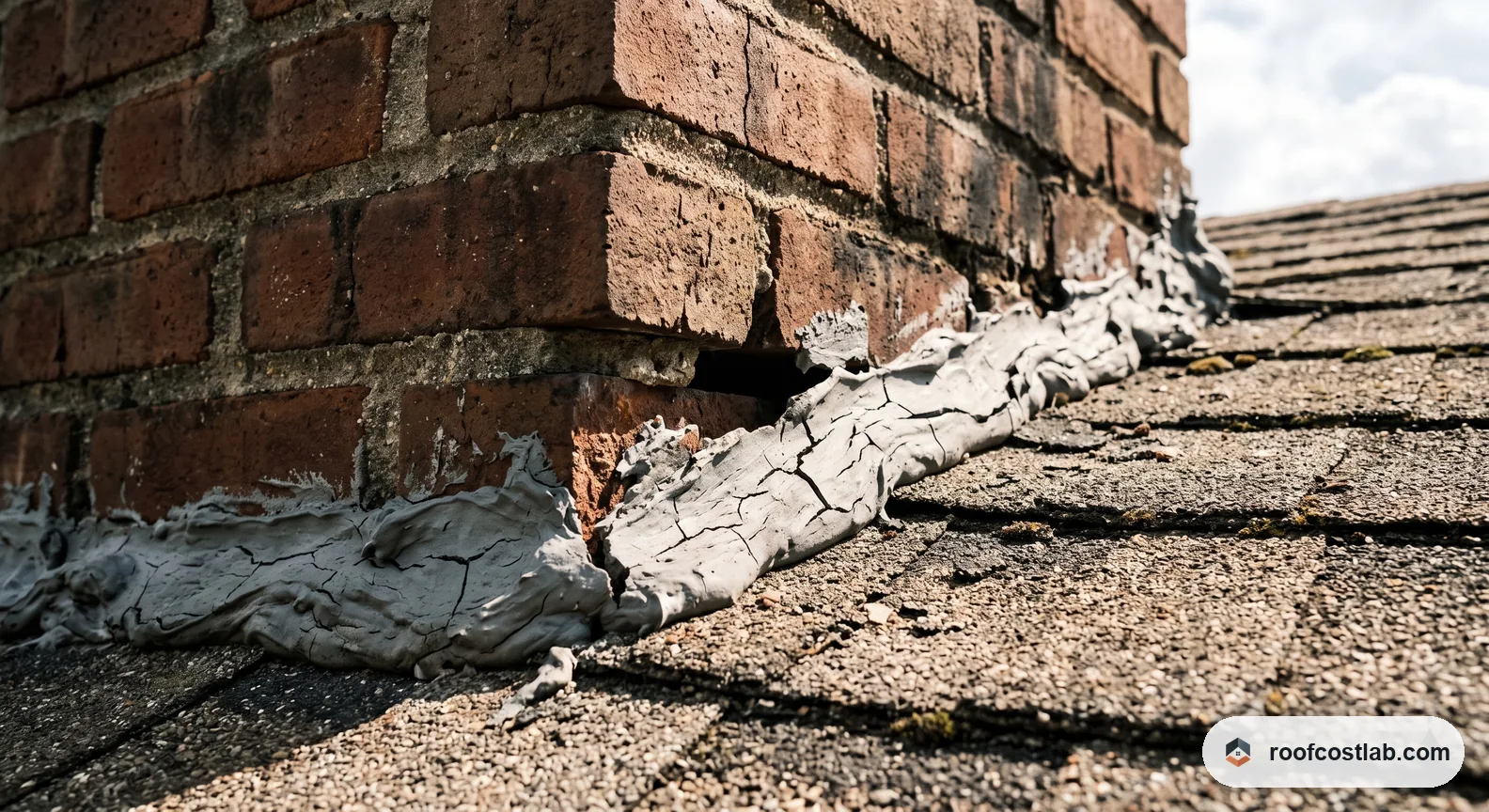
Sealant used instead of lap is the first: a continuous strip where step flashing belongs, or a bead of caulk across a joint, both of which work briefly. Reused flashing is the second: a crew tears off shingles, leaves twenty-year-old flashing in place because it looks fine, and the new roof inherits an old failure point. Missing kick-out is the third, and it does the most hidden damage because the water goes into the wall rather than the ceiling. Perished pipe boots are the fourth, and the easiest to fix.
The diagnostic tell is that a flashing leak usually appears away from the flashing. Water travels along the deck and the rafters before it drops, sometimes many feet, so the stain on the ceiling is rarely under the hole. Finding the entry point is a real part of what roof repair is priced for.
What flashing work costs in 2026
Flashing is cheap as a line item and expensive as an omission. Replacing it during a re-roof adds little, because the crew and the staging are already there. Chasing a flashing leak on an otherwise sound roof costs more, because most of the bill is diagnosis and access rather than metal.
| Job | Typical range | Priced at |
|---|---|---|
| New flashing during a re-roof | $300 to $1,000 | Flashing installation |
| Flashing repair, localised | $300 to $1,000 | Flashing repair |
| Chimney flashing, rebuilt | $500 to $1,600 | Chimney flashing repair |
| Valley repair or replacement | $400 to $1,500 | Valley repair |
| Pipe boot replacement | $150 to $400 | Flashing repair |
Ranges assume a single-storey walkable roof and no structural damage beneath. Where water has been entering long enough to soften the deck, add decking repair.
Put this to work